Gidugayon ug Gasto sa Sesyon
Unsa ka dugay molungtad ang pundo sa dula sa usa ka gihatag nga pusta, ug pila ang gasto sa mga oras. Ang mga numero nga wala gayud kuwentaha sa kadaghanan sa mga magdudula ug angay unta.

Ang patag nga even-money nga pagpusta molungtad, sa average, og 37 ka tuyok matag pusta nga anaa sa pundo, bisan og ang katunga sa tanang sesyon mahuman nga mas sayo pa niana; ang gidahom nga gasto matag oras kay pusta × tuyok matag oras / 37. Sa tingub, matagaan nimo og presyo ang usa ka gabii sa dili pa kini magsugod.
Unsa ka dugay molungtad ang pundo
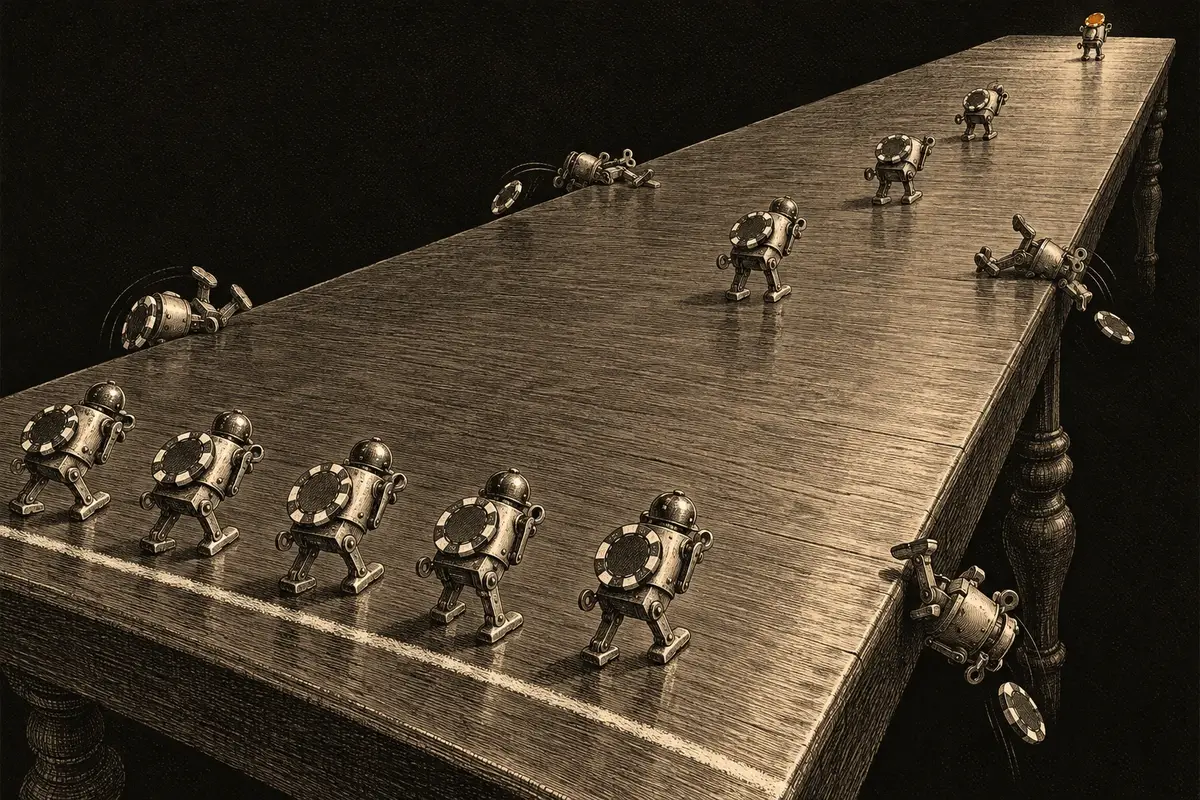
Assume standard single-zeroligidSeroAng usa ra ka berde nga bulsa nga walay even-money, dosena o kolum nga pusta ang motabon; ang gigikanan sa bentaha sa casino. Gitawag usab: single zero, 0.Basaha tanan → rules, independent spinsmatematikaIndependente nga mga tuyokAng matag tuyok adunay parehas nga mga probabilidad bisan unsa pa ang kasaysayan. Ang sukaranan sa matag kuwenta niini nga site.Basaha tanan →, a fixed stake s, a bankrollkwartaPundo sa dulaAng tibuok kantidad nga gigahin alang sa pagdula. Ang pagdumala sa pundo sa dula mao ang pagdesisyon kon pila niini ang irisgo matag pusta ug matag sesyon.Basaha tanan → B that is an integer multiple of s, and play continuing until the balance reaches zero. With these assumptions, the bankroll drifts down by s/37 a spin on average and swings by about s a spin either way. The drift alone sets the average: the bankroll lasts 37 × B/s spins, since that is how long it takes to lose B at s/37 a spin. The swings make the lengths uneven. Some sessions die early on a bad run, a few last far longer, and the median, the length half of all sessions fail to reach, sits below the average. A $500 bankroll at $10 (B/s = 50) lasts 1,850 spins on average and 1,364 at the median, about 27 hours at an illustrative 50 spins per hour. At $50 (B/s = 10) the median is 136 spins, under three hours.
Pila ang gasto sa mga oras
Expected lossmatematikaGidahom nga kapildihanAng gidahom nga bili gipadaghan sa tibuok kantidad nga gipusta; ang average nga kantidad nga mapildi sulod sa usa ka sesyon o usa ka yugto.Basaha tanan → per hour = stake × spins per hour / 37. The two numbers you control are the stake and the pace. If all planned spins are played, $10 standard single-zero bets at 50 spins per hour have an expected hourly loss of $13.51. La partagelagdaLa partagePranses nga lagda: kon mogawas ang sero, ang katunga sa even-money nga pusta ibalik. Gitunga ang bentaha sa casino sa maong mga pusta ngadto sa 1.35%.Basaha tanan → on eligible even-money betspustaEven-money nga pustaPula/itom, gansal/parehas, taas/ubos. 18 ka numero, mobayad og 1:1.Basaha tanan → reduces that to $6.76. Doubling the pace to 100 spins per hour doubles the standard expected loss to $27.03. These are averages, not hourly fees or loss limits.
Paghiusa niini
Consider $500 for up to 200 standard single-zero redpustaPulaEven-money nga pusta sa 18 ka pula nga numero. Sa Pranses: rouge.Basaha tanan → bets. At a fixed $25 stake, the chance of reaching zero within those spins is about 25.9%. A median ruin time of 394 spins therefore does not make a 200-spin session safe. If play stops at ruin or after 200 spins, expected turnoverkwartaKinatibuk-ang gipustaAng tibuok kantidad nga gipusta sulod sa usa ka sesyon o yugto, lakip ang mga daog nga gipusta pag-usab. Gitawag usab: handle, action.Basaha tanan → gives an expected loss of about $122.52; $135.14 is the figure assuming all 200 bets are made. At a $10 stake, the ruin probabilitymatematikaProbabilidadTsansa sa usa ka resulta, gikan sa 0 hangtod 1 o 0% hangtod 100%. Usa ka numero: 1/37 = 2.70%.Basaha tanan → falls to about 0.143%, with an expected loss of about $54.05. Choose stakes within a loss budget; none of these figures guarantees survival.
- p10 −$500
- p25 −$500
- median −$500
- p75 −$50
- p90 +$350
Mga sesyon sa pusta sa usa ka numero
A straight-up bet has much greater variability per unitkwartaYunitAng base nga pusta nga gigamit sa usa ka sistema o magdudula. Ang mga progresyon gihulagway sa mga yunit aron magamit kini sa bisan unsang lamesa.Basaha tanan → staked than red: standard deviationmatematikaStandard deviationSquare root sa variance; ang kasagarang gilay-on sa usa ka resulta gikan sa gidahom nga bili.Basaha tanan → about 5.84 units versus 1. Over a 200-spin single-zero session, a bankroll of 13 fixed red stakes has about a 49.1% chance of ruin. For one straight-up number, 56 stakes gives about 52.7% ruin and 57 stakes about 47.5%. These comparisons depend on the horizon and bet; there is no universal four-times-bankroll rule. With only 20 straight-up stakes, the first 20 spins all miss about 57.8% of the time, ending the session immediately.
Ang matinuoron nga listahan sa presyo
Ang roulette nagkantidad og pusta × tuyok / 37. Ang tanan uban pa, ang sistema, ang swerte nga numero, ang hedge, mohukom sa porma sa gabii ug dili sa presyo niini. Ang magdudula nga mokuwenta una sa presyo ug mopili og pusta nga malipay siyang bayran nakahimo sa bugtong bahin sa estratehiya nga molihok.
Pormula
Mga pangutana
Walay eksakto. Para sa gamay nga pundo ang mga ilog-ilog ang modominar ug ang median motubo halos sama sa (B/s)², sama sa patas nga sensilyo. Para sa dako ang bentaha ang modominar ug ang median moduol sa average, 37 × B/s. Sa mga 20 ka pusta ang (B/s)² nga lagda nahitabo nga motakdo sa eksakto nga median, 394 ka tuyok; ubos niana kini mubo ug ibabaw niana kini taas.
Stopping reduces expected turnover and therefore expected loss. A stated stop-lossestratehiyaStop-lossUsa ka gitakda daan nga kantidad sa kapildihan diin imong tapuson ang sesyon.Basaha tanan → can be exceeded by the final losing bet unless the remaining allowance limits that stake. It does not improve the odds of the bets already placed.
La partage halves expected loss per eligible even-money bet. Dividing bankroll by the mean loss per full stake suggests 74 × B/s spins, but this is not an exact session-length formula: half-losses can leave less than a full stake, and table minimums or smaller final bets change the stopping process.
Lingaw sa Matematika
Sulayi una kini sa imong kaugalingon. Ang matag solusyon gitakpan; ablihi kini kon andam na ka.
Start with $500 and bet $10 on redpustaPulaEven-money nga pusta sa 18 ka pula nga numero. Sa Pranses: rouge.Basaha tanan → on each independent, uniform single-zeroligidSeroAng usa ra ka berde nga bulsa nga walay even-money, dosena o kolum nga pusta ang motabon; ang gigikanan sa bentaha sa casino. Gitawag usab: single zero, 0.Basaha tanan → spin. Stop only when the bankrollkwartaPundo sa dulaAng tibuok kantidad nga gigahin alang sa pagdula. Ang pagdumala sa pundo sa dula mao ang pagdesisyon kon pila niini ang irisgo matag pusta ug matag sesyon.Basaha tanan → reaches zero, with no upper target and a bank that can always pay. How many spins does the bankroll last on average?
Ipakita ang solusyon
Tubag 1,850 ka tuyok: 37 ka tuyok alang sa matag usa sa 50 ka pusta.
Each spin costs, on average, 1/37 of the stake: $10/37, about 27 cents. The bankroll holds 50 stakes, and losing 50 stakes at 1/37 of a stake a spin takes 50 × 37 = 1,850 spins.
The swings do not change this average, because a session can only end at zero and every spin before that costs the same 27 cents on average. They change the spread: half of all sessions are over by spin 1,364, and about one in twenty runs past 5,000, which pulls the average up.
For this fixed-stake even-money random walk, with no upper boundary, the mean time to zero is the initial number of stakes divided by the house edgematematikaBentaha sa casinoAng bahin sa matag pusta nga gitipigan sa casino sa average: 2.70% sa Uropanhon nga roulette.Basaha tanan →. On a standard double-zero wheel the same $500 bankroll at $10 per spin therefore lasts 50 ÷ (2/38) = 950 spins on average. A time limit, profit target or changing stakes defines a different stopping problem.
Komiks nga pahulay
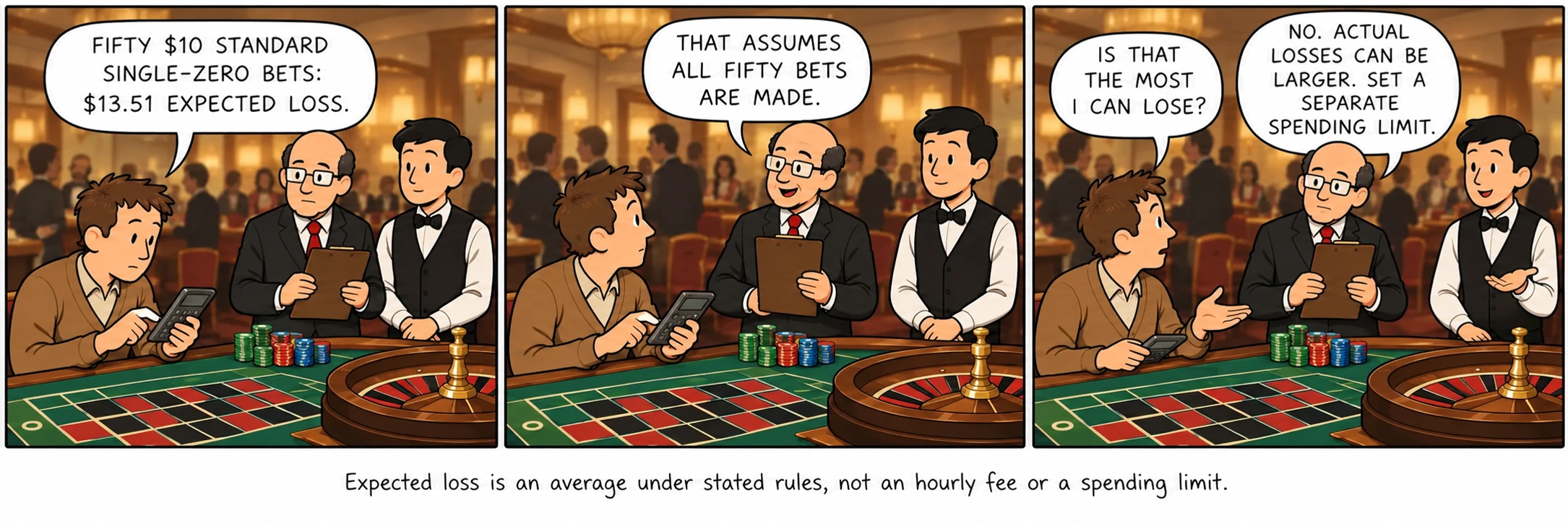
Pusta × tuyok / 37. Tagai og presyo ang gabii sa dili pa kini magsugod.
Mga Tinubdan
- Feller, W. An Introduction to Probability Theory and Its Applications, Vol. 1.
- Ethier, S. N. The Doctrine of Chances: Probabilistic Aspects of Gambling.
- Epstein, R. A. The Theory of Gambling and Statistical Logic, 2nd ed.