Kelly Criterion ug Roulette
Ang Kelly criterion mosulti sa usa ka mopusta nga adunay bentaha kon pila ang ipusta. Para sa roulette klaro ang tubag niini: wala.

Kelly nga pusta = bentaha / odds. Uban sa negatibo nga bentaha ang pormula mohatag og negatibo nga bahin, nga nagpasabot nga ayaw pagpusta. Mapuslanon gihapon ang criterion aron masabtan nganong ingon niadto ang gidak-on sa pusta sa mga magdudula sa nagkiling nga ligid, ug nganong ang tanan uban pa kinahanglang mosukod sa pusta pinaagi sa badyet.
Ang criterion
John Kelly (1956) asked how a gambler with a known edge should size bets to maximize long-run growth of the bankrollkwartaPundo sa dulaAng tibuok kantidad nga gigahin alang sa pagdula. Ang pagdumala sa pundo sa dula mao ang pagdesisyon kon pila niini ang irisgo matag pusta ug matag sesyon.Basaha tanan →. The answer, for a bet paying b to 1 with win probabilitymatematikaProbabilidadTsansa sa usa ka resulta, gikan sa 0 hangtod 1 o 0% hangtod 100%. Usa ka numero: 1/37 = 2.70%.Basaha tanan → p and loss probability q = 1 − p, is to stake the fraction f* = (bp − q) / b of the bankroll. Positive f* means bet that fraction; zero or negative means do not bet. Kelly worked at Bell Labs, and his paper, “A new interpretation of information rate”, set the problem in Claude Shannon’s theory of information: a gambler who gets tips over a noisy line, at fair odds, can grow the bankroll at best at the rate the line carries information. This is a growth objective under a probability model, not a promise to finish ahead after a particular number of bets. A spending limit, finite deadline or payoutkwartaBayad sa daogUnsay ibalik sa nidaog nga pusta, gipahayag isip “X sa 1” dugang sa gibalik nga pusta.Basaha tanan → cap changes the decision problem.
Kelly nga pagpusta sa roulette
For redpustaPulaEven-money nga pusta sa 18 ka pula nga numero. Sa Pranses: rouge.Basaha tanan →: b = 1, p = 18/37, q = 19/37; f* = (18/37 − 19/37)/1 = −1/37. For a straight uppustaUsa ka numeroUsa ka numero, mobayad og 35:1.Basaha tanan →: b = 35, p = 1/37, q = 36/37; f* = (35/37 − 36/37)/35 = −1/1295. Every standard bet gives a negative Kelly fraction, because every bet has a negative edge, and the growth-optimal stake is zero. Kelly betting on roulette is a formal way of saying what the house-edge page says: no positive stake maximizes expected logarithmic growth when the bet has negative expectation. A particular session can still end in profit. La partagelagdaLa partagePranses nga lagda: kon mogawas ang sero, ang katunga sa even-money nga pusta ibalik. Gitunga ang bentaha sa casino sa maong mga pusta ngadto sa 1.35%.Basaha tanan → needs a separate three-outcome calculation: a win, a full loss or a half-loss on zeroligidSeroAng usa ra ka berde nga bulsa nga walay even-money, dosena o kolum nga pusta ang motabon; ang gigikanan sa bentaha sa casino. Gitawag usab: single zero, 0.Basaha tanan →. Its expected log growth also falls as the stake increases from zero.
Asa nigamit ang Kelly
Suppose a pocketkagamitanBulsaUsa sa 37 ka numerado nga kompartamento sa rotor. Gitawag usab: slot, cup.Basaha tanan → really has a stable, known probability of 1 in 30 and pays 35 to 1. The Kelly fraction is 0.57%: about $57 from a $10,000 bankroll. Under independent spinsmatematikaIndependente nga mga tuyokAng matag tuyok adunay parehas nga mga probabilidad bisan unsa pa ang kasaysayan. Ang sukaranan sa matag kuwenta niini nga site.Basaha tanan → and exact fractional staking, the geometric growth factor over 1,000 spins is about 1.7. Expected bankroll grows faster because rare large wins pull up the average. These are model calculations, not evidence that any named historical player used Kelly or achieved this result.
Tipikal ug average
The gap between the typical bankroll and the average one is wide. Take a pocket that hits 1 time in 25, a hypothetical edge of 44% per unitkwartaYunitAng base nga pusta nga gigamit sa usa ka sistema o magdudula. Ang mga progresyon gihulagway sa mga yunit aron magamit kini sa bisan unsang lamesa.Basaha tanan → staked. Kelly stakes 1.26% of the bankroll on it. After 1,000 spins the typical bankroll has grown about 11.5 times, while the average, pulled up by a few very lucky runs, has grown about 249 times. Betting more than Kelly raises the average and lowers the typical result: at twice the Kelly stake the typical bankroll only doubles, and by two and a half times the Kelly stake it shrinks, although every bet still carries a 44% edge. In this example, half-Kelly retains about 78% of the expected log growth. This fraction depends on the probabilities and payout.
Kon tag-an lang ang bentaha
Kelly uses the true probabilities, but a player usually has only estimates. Selecting the busiest pocket from a past record creates a selection problem: even a fair wheel has a busiest pocket. Its observed rate can overstate its future probability. Choosing the stake from that same record compounds the error. An independent follow-up sample helps test a proposed bias (see How to Detect Roulette Wheel Bias). Reducing the calculated fraction reduces exposure, but cannot turn a false edge into a real one.
Mga tawo nga adunay bentaha
Haghani and Dewey (2016) studied 61 participants given $25 and 30 minutes to bet on a simulated coin with a disclosed 60% chance of heads. The payout cap was $250; its value was revealed when a proposed winning bet would reach it. Their reported 21% success category included balances of at least $200, while the 28% “bust” category meant less than $2, not necessarily zero. Eighteen participants bet their entire balance on one flip. The uncapped Kelly fraction is 20%, but the cap and deadline change the optimization problem. The experiment illustrates how stake choices matter even with a known advantage; it does not establish one best strategy for every objective.
Unsay gamiton puli niini
Kon walay bentaha, ang gidak-on sa pusta pangutana sa badyet, dili pangutana sa pagtubo: pusta = ang andam nimong gastohon matag tuyok, nga gikuha gikan sa badyet matag oras ug sa gikusgon sa lamesa (panid sa Pagdumala sa Pundo sa Dula sa Roulette). Ang kontribusyon sa Kelly sa ordinaryong magdudula mao ang kaklaro sa tubag niini: sero. Ang tanan nga imong ipusta labaw sa sero mao ang presyo sa pagdula, nga ikaw ang mipili, dili gi-optimize sa bisan unsang pormula.
Usa ka nota bahin sa fractional Kelly ug “money management”
Betting a fixed percentage of the current bankroll is proportional staking: the stake rises after wins and falls after losses. Flat bettingestratehiyaPatag nga pagpustaPagpusta og parehas nga kantidad matag tuyok. Ang sukaranan nga gitandian sa matag progresyon.Basaha tanan → instead keeps the cash stake fixed. Neither creates an edge on ordinary roulette. With infinitely divisible stakes and a fraction below 100%, proportional staking never reaches exactly zero in finitely many losses, but the balance can become arbitrarily small. Real table minimums can prevent further play much sooner. The growth-optimal fraction remains zero.
Pormula
Mga pangutana
Only when the actual probabilities, payouts and conditions give a credible positive advantage. Standard bets on an unbiased wheel have no such advantage.
Using half the calculated fraction reduces exposure to errors in the estimated edge. The familiar three-quarters-growth rule is an approximation for small advantages, not a universal identity. It does not protect against an edge that does not exist.
Dili. Ang Kelly mo-optimize sa pagtubo kon adunay bentaha. Ang pagdumala sa pundo mokontrolar sa paggasto kon walay bentaha.
Lingaw sa Matematika
Sulayi una kini sa imong kaugalingon. Ang matag solusyon gitakpan; ablihi kini kon andam na ka.
Suppose a hypothetical bet on one number has a known 44% edge under standard payoutskwartaBayad sa daogUnsay ibalik sa nidaog nga pusta, gipahayag isip “X sa 1” dugang sa gibalik nga pusta.Basaha tanan → and independent spinsmatematikaIndependente nga mga tuyokAng matag tuyok adunay parehas nga mga probabilidad bisan unsa pa ang kasaysayan. Ang sukaranan sa matag kuwenta niini nga site.Basaha tanan →. Kelly gives a 1.26% bankrollkwartaPundo sa dulaAng tibuok kantidad nga gigahin alang sa pagdula. Ang pagdumala sa pundo sa dula mao ang pagdesisyon kon pila niini ang irisgo matag pusta ug matag sesyon.Basaha tanan → fraction. What if the same 44% edge came on one bet spread over five neighboring numbers?
Ipakita ang solusyon
Tubag Ang Kelly unya moingon og 7.1% sa pundo, ug ang pundo motubo hapit unom ka pilo ka paspas: mga 1.25 milyon ka pilo sa 1,000 ka pusta, batok sa mga 11.5 ka pilo.
A straight uppustaUsa ka numeroUsa ka numero, mobayad og 35:1.Basaha tanan → with a 44% edge wins with chance 0.04, since 36 × 0.04 = 1.44. Kelly’s stake is the edge divided by the odds: 0.44/35 = 1.26%. The typical growth per bet is 0.04 × ln(1 + 35 × 0.0126) + 0.96 × ln(1 − 0.0126) ≈ 0.00244, so 1,000 bets multiply the bankroll by about e^2.44 ≈ 11.5.
Spread one stake over five numbers and the bet wins with chance 0.20 and pays 36/5 for 1, that is 6.2 to 1: still a 44% edge, since 0.2 × 7.2 = 1.44. Kelly’s stake becomes 0.44/6.2 = 7.10%, and the growth per bet 0.01404, about 5.75 times as much. Over 1,000 bets that is e^14.04, about 1.25 million.
The edge is the same; the swings are smaller. A bet that wins one time in five has a larger growth-optimal fraction in this model, although losses can still reduce the bankroll severely. This comparison assumes the same known edge for both bets; actual predictions need independent evidence.
Assume two numbers are adjacent on the betting layoutkagamitanLayout sa pustahanAng giimprinta nga grid sa pagpusta sa lamesa. Gitawag usab: table, felt, cloth.Basaha tanan → and each has a stable, known probabilitymatematikaProbabilidadTsansa sa usa ka resulta, gikan sa 0 hangtod 1 o 0% hangtod 100%. Usa ka numero: 1/37 = 2.70%.Basaha tanan → of 1 in 25 on independent spins. Compare a splitpustaSplitDuha ka magkasikbit nga numero, mobayad og 17:1.Basaha tanan → between them at 17 to 1 with equal straight-up stakes on the two numbers. How much does Kelly say, and how fast does the bankroll grow compared with one such pocketkagamitanBulsaUsa sa 37 ka numerado nga kompartamento sa rotor. Gitawag usab: slot, cup.Basaha tanan →?
Ipakita ang solusyon
Tubag Walay kalainan: 2.59% sa pundo sa split, o 1.29% sa matag numero. Ang tipikal nga pundo motubo og mga 155 ka pilo sa 1,000 ka tuyok, batok sa 11.5 ka pilo sa usa ka bulsa.
The split wins with probability 2/25 = 0.08 and pays 17 to 1, so it returns 18 × 0.08 = 1.44 per unitkwartaYunitAng base nga pusta nga gigamit sa usa ka sistema o magdudula. Ang mga progresyon gihulagway sa mga yunit aron magamit kini sa bisan unsang lamesa.Basaha tanan → staked: an edge of 44%, the same as one biased pocket. Kelly’s stake is the edge divided by the odds: 0.44/17 = 2.59%.
Two straight-up bets of 1.29% each give exactly the same results. When either number comes up, one chipkwartaChipUsa ka token nga nagrepresentar og piho nga kantidad, gibutang sa layout aron makapusta. Gitawag usab: check.Basaha tanan → wins 35 to 1 and the other is lost, a net of 34 × 1.29% = 44% of the bankroll, as the split pays; when neither does, both are lost.
The growth per spin is 0.00505, against 0.00244 for one pocket, so over 1,000 spins the typical bankroll grows e^5.046 ≈ 155 times rather than e^2.44 ≈ 11.5 times. The geometric growth factor is larger because the combined bet wins more often at the same 44% edge. It is a model result, not a guaranteed bankroll.
Komiks nga pahulay
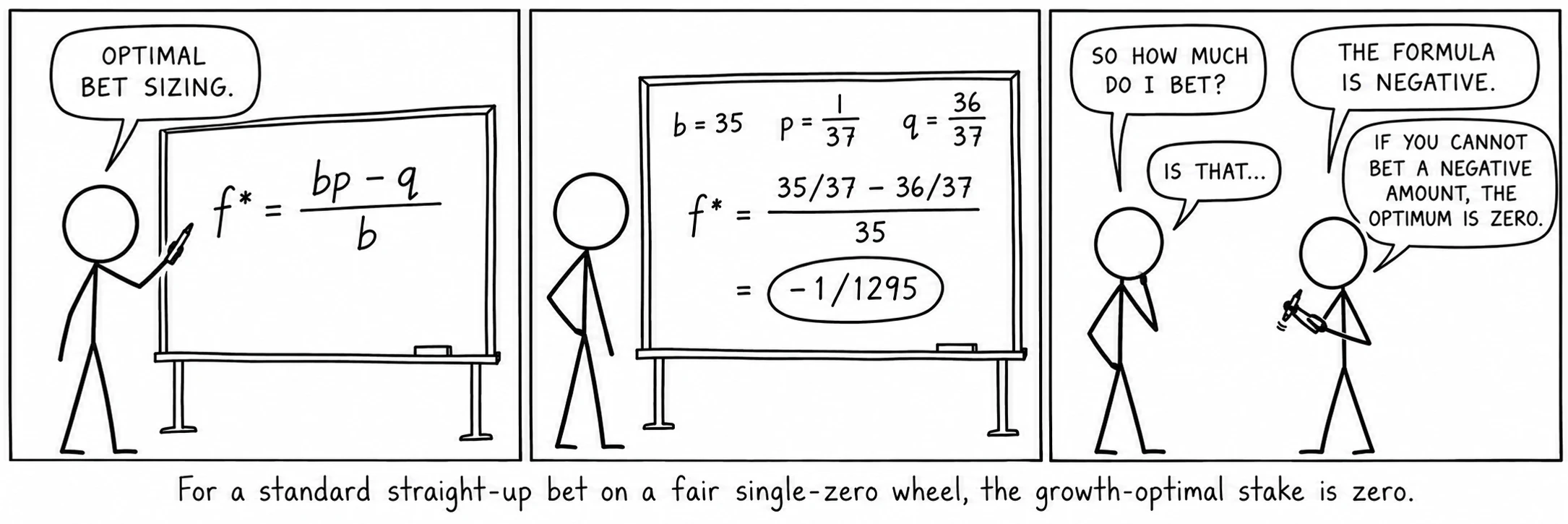
Ang pusta sa roulette nga labing maayo para sa pagtubo usa ka numero nga nahibaloan na sa tanan.
Mga Tinubdan
- Kelly, J. L. “A new interpretation of information rate.”
- Breiman, L. “Optimal gambling systems for favorable games.”
- Thorp, E. O. “Optimal gambling systems for favorable games.”
- Thorp, E. O. The Mathematics of Gambling.
- Epstein, R. A. The Theory of Gambling and Statistical Logic, 2nd ed.
- Taylor, D. G. Games, Gambling, and Probability: An Introduction to Mathematics, 2nd ed.
- Ethier, S. N. The Doctrine of Chances: Probabilistic Aspects of Gambling.
- Haghani, V. & Dewey, R. “Rational decision-making under uncertainty: observed betting patterns on a biased coin.”