Problema: Ang Limitasyon sa Lamesa
Usa ka $10 nga Martingale sa lamesa nga $500. Unsa ka kanunay kini mabuak, pila ang mapildi kon mabuak, ug makatabang ba ang pagpataas sa limitasyon?
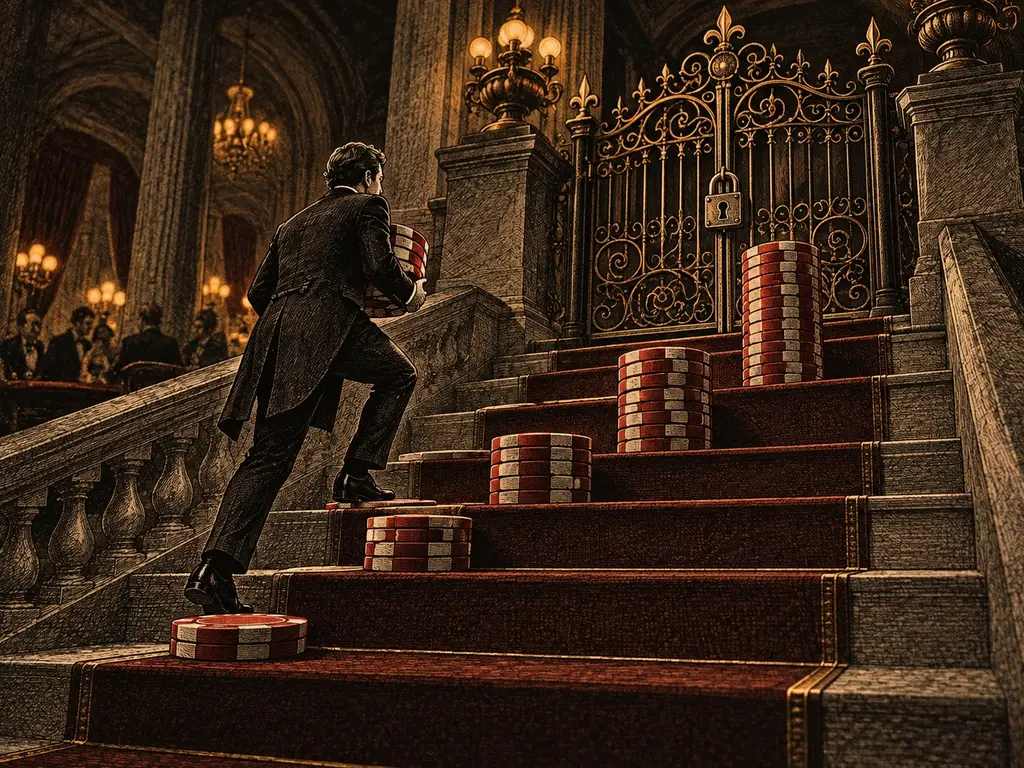
Unom ka sunod-sunod nga pildi ang mobuak niini: 1.8% matag siklo, mga 60% sa mga sesyon nga 100 ka tuyok. Ang pagkabuak nagkantidad og $630. Ang pagpataas sa limitasyon ngadto sa $5,000 mohimo nga mas talagsa ang pagkabuak (0.25% matag siklo) ug mas dako ($5,110). Ang gidahom nga kapildihan matag dolyar nga gipusta 2.70% sa bisan unsang limitasyon.
Ang problema
Assume independent spinsmatematikaIndependente nga mga tuyokAng matag tuyok adunay parehas nga mga probabilidad bisan unsa pa ang kasaysayan. Ang sukaranan sa matag kuwenta niini nga site.Basaha tanan → and standard single-zeroligidSeroAng usa ra ka berde nga bulsa nga walay even-money, dosena o kolum nga pusta ang motabon; ang gigikanan sa bentaha sa casino. Gitawag usab: single zero, 0.Basaha tanan → payoutskwartaBayad sa daogUnsay ibalik sa nidaog nga pusta, gipahayag isip “X sa 1” dugang sa gibalik nga pusta.Basaha tanan →, with enough bankrollkwartaPundo sa dulaAng tibuok kantidad nga gigahin alang sa pagdula. Ang pagdumala sa pundo sa dula mao ang pagdesisyon kon pila niini ang irisgo matag pusta ug matag sesyon.Basaha tanan → to fund each permitted stake. A player bets $10 on redpustaPulaEven-money nga pusta sa 18 ka pula nga numero. Sa Pranses: rouge.Basaha tanan → and doubles after each loss, resetting after a win. The table maximum is $500. (a) How many consecutive losses break the progressionestratehiyaProgresyonBisan unsang lagda nga mag-usab sa pusta base sa miaging mga resulta. Ang negatibo nga mga progresyon mopataas niini human sa pildi, ang positibo human sa daog.Basaha tanan →? (b) What is the probabilitymatematikaProbabilidadTsansa sa usa ka resulta, gikan sa 0 hangtod 1 o 0% hangtod 100%. Usa ka numero: 1/37 = 2.70%.Basaha tanan → per cycle? (c) What is lost at the break? (d) How does a $5,000 limit change the answers? (e) Does any limit make the system profitable?
Mga solusyon (a)–(c)
Mga pusta: 10, 20, 40, 80, 160, 320. Ang ikapito 640 > 500, busa unom ka pildi ang mobuak niini. (b) p(pildi) = 19/37 sa pula; (19/37)⁶ = 0.0183, mga 1.8% matag siklo. Ang usa ka siklo molungtad og mga duha ka tuyok sa average, busa ang sesyon nga 100 ka tuyok adunay mga 50 ka siklo ug p(labing menos usa ka pagkabuak) ≈ 1 − 0.9817⁵⁰ ≈ 60%. (c) 10 + 20 + 40 + 80 + 160 + 320 = $630, nga 63 ka base nga yunitkwartaYunitAng base nga pusta nga gigamit sa usa ka sistema o magdudula. Ang mga progresyon gihulagway sa mga yunit aron magamit kini sa bisan unsang lamesa.Basaha tanan →, batok sa $10 nga gisulayan nga madaog sa siklo.
Solusyon (d)
At $5,000: stakes to 2,560 are allowed; the tenth stake, 5,120, is refused. Nine losses break it: (19/37)⁹ ≈ 0.25% per cycle, about 11% of 100-spin sessions. Loss at the break: 10 + 20 + … + 2,560 = $5,110. The player has bought a rarer catastrophe at the price of a larger one. Over many sessions the expected cost of breaks is p × loss ≈ 0.0183 × 630 = $11.5 per cycle at the $500 limit and 0.0025 × 5,110 = $12.8 at $5,000; each is the expected contribution from failed cycles. Subtract the expected profit from successful cycles, $10 × (1 − p), to obtain total expected lossmatematikaGidahom nga kapildihanAng gidahom nga bili gipadaghan sa tibuok kantidad nga gipusta; ang average nga kantidad nga mapildi sulod sa usa ka sesyon o usa ka yugto.Basaha tanan → per cycle: about $1.74 and $2.71 respectively.
Solusyon (e)
With a finite limit and a well-defined stopping rule, expected loss equals expected turnoverkwartaKinatibuk-ang gipustaAng tibuok kantidad nga gipusta sulod sa usa ka sesyon o yugto, lakip ang mga daog nga gipusta pag-usab. Gitawag usab: handle, action.Basaha tanan → divided by 37. Changing the limit can change turnover substantially. For the 100-spin examples below, the player resets to $10 after either a win or a failed progression, and has enough money to place every bet. These are exact model expectations, not a simulation. The imaginary unlimited-bankroll, unlimited-stake MartingaleestratehiyaMartingaleProgresyon nga modoble sa pusta human sa matag pildi. Tan-awa ang seksyon sa Estratehiya kon unsay mahimo ug dili mahimo niini.Basaha tanan → is different: a single cycle eventually wins $10 with probability 1, but its expected turnover is infinite. The finite-expectation identity cannot be applied to that unbounded stopping problem. Real bankrolls and tables cannot implement it.
Duha ka tinuod nga lamesa
Ang pananglitan ni Thorp usa ka $1 nga lamesa nga adunay $1,000 nga maximum, diin ang magdudula naglaum nga makadaog og $30 para sa panihapon usa ka dolyar matag higayon. Ang mga pusta nga 1, 2, 4 … 512 motugot og napulo ka pusta, busa ang napulo ka sunod-sunod nga pildi mobuak sa progresyon: kausa sa 785 ka siklo sa Uropanhon nga ligid (kausa sa 613 sa Amerikano), sa gasto nga $1,023. Ang traynta ka siklo molampos tanan 96.2% sa panahon. Ang laing 3.8% mapildi og mga $1,000, ug ang average nga resulta sa gabii −$9.17, nga eksaktong 1/37 sa $339 nga gipusta sa traynta ka siklo sa average. Ang $5 nga lamesa nga adunay $2,000 nga maximum walay kalainan: ang mga pusta hangtod $1,280 motugot og siyam ka pusta, ug ang pagkabuak moabot kausa sa 403 ka siklo sa Uropanhon nga ligid (kausa sa 323 sa Amerikano) ug nagkantidad og $2,555.

Usa ka adunahan nga magdudula
The table maximum is only one constraint. The player may run out of money before reaching it. A simulation must state whether it stops, resets to the base stake or bets the remaining balance when the next double is unaffordable. Those choices change session probabilities, so results from one rule cannot describe every Martingale strategy.
Ang leksyon
A higher limit permits rarer but larger failed progressions. It does not remove the negative expectation of each standard bet, and it may increase the amount wagered. Compare the total exposure and stopping rule as well as the chance of a short winning cycle.
Pormula
Mga pangutana
Tugotan ka niini nga molahutay hangtod sa mas taas nga limitasyon, diin mas talagsa ug mas dako ang pagkabuak. Ang gidahom nga kapildihan matag dolyar walay kausaban.
Mga pusta 10, 30, 70, 150, 310: maigo ang $500 nga limitasyon human sa lima ka pildi, ug ang pagkabuak nagkantidad og $570. Parehas nga 2.70%.
A maximum limits the payout exposure accepted on a bet. The operator sets the actual limits; their existence does not create roulette’s house edgematematikaBentaha sa casinoAng bahin sa matag pusta nga gitipigan sa casino sa average: 2.70% sa Uropanhon nga roulette.Basaha tanan →.
Lingaw sa Matematika
Sulayi una kini sa imong kaugalingon. Ang matag solusyon gitakpan; ablihi kini kon andam na ka.
A MartingaleestratehiyaMartingaleProgresyon nga modoble sa pusta human sa matag pildi. Tan-awa ang seksyon sa Estratehiya kon unsay mahimo ug dili mahimo niini.Basaha tanan → starts at $100 on redpustaPulaEven-money nga pusta sa 18 ka pula nga numero. Sa Pranses: rouge.Basaha tanan → and allows itself at most n bets a cycle: after n losses in a row it gives up and starts again. Write the average result of one cycle as a formula in n, and work it out for 5, 6 and 7 bets on a European wheel. Assume independent uniform single-zeroligidSeroAng usa ra ka berde nga bulsa nga walay even-money, dosena o kolum nga pusta ang motabon; ang gigikanan sa bentaha sa casino. Gitawag usab: single zero, 0.Basaha tanan → results and sufficient funds for every permitted stake.
Ipakita ang solusyon
Tubag Ang average 100 × (1 − (38/37)ⁿ): −$14.26 alang sa 5 ka pusta, −$17.35 alang sa 6 ug −$20.52 alang sa 7. Ang pagtugot og mas daghang pusta mopadaotan sa average nga siklo, dili mopaayo.
A cycle wins $100 unless all n bets lose, which happens with chance qⁿ, where q = 19/37. When they all lose, the stakes 100, 200 … 100 × 2ⁿ⁻¹ add up to 100 × (2ⁿ − 1). So the average is 100 × (1 − qⁿ) − 100 × (2ⁿ − 1) × qⁿ = 100 × (1 − (2q)ⁿ).
Here 2q = 38/37, a little more than 1, so (2q)ⁿ grows with n and the average falls: n = 5 gives 1.1426 and −$14.26; n = 6 gives 1.1735 and −$17.35; n = 7 gives 1.2052 and −$20.52. A longer ladder loses less often, in 3.6%, 1.8% and 0.9% of cycles, but each loss is twice as large, and more money crosses the table each cycle, at 2.70% of every bet.
On an American wheel 2q = 40/38 and the figures are −$29.24, −$36.04 and −$43.20. In a game with no zero 2q = 1, and every cycle averages exactly zero however long the ladder.
Ang “grand Martingale” modoble sa pusta human sa pildi ug modugang og usa ka yunitkwartaYunitAng base nga pusta nga gigamit sa usa ka sistema o magdudula. Ang mga progresyon gihulagway sa mga yunit aron magamit kini sa bisan unsang lamesa.Basaha tanan →, busa ang mga pusta mahimong 1, 3, 7, 15, 31 … Pila ang imong ganansya kon ang unang daog moabot sa ika-1, ika-2, ika-3 o ika-k nga pusta? Sa $10 nga yunit ug $500 nga maximum, unsa ka kanunay mabungkag ang siklo, ug pila ang gasto sa usa ka siklo sa average?
Ipakita ang solusyon
Tubag Ang daog sa ika-k nga pusta mobilin kanimo og k ka yunit nga ganansya: +1, +2, +3 ug uban pa. Sa $10 ug $500 ang siklo mabungkag human sa lima ka pildi, 3.57% sa mga siklo, alang sa −$570. Sa average ang siklo mapildi og $2.32 sa $85.73 nga gipusta: 2.70%.
The kth stake is 2ᵏ − 1 units: 1, 3, 7, 15, 31. The first k − 1 stakes add up to 2ᵏ − 2 − (k − 1) = 2ᵏ − k − 1. A win on the kth bet pays 2ᵏ − 1, so the cycle ends (2ᵏ − 1) − (2ᵏ − k − 1) = k units up: one extra unit for every loss before the win.
At least $570 is needed to fund all five stakes in a fresh cycle. At $10 a unit the stakes are $10, $30, $70, $150 and $310; the next, $630, is over the $500 maximum. Five losses in a row, (19/37)⁵ = 3.57%, cost 10 + 30 + 70 + 150 + 310 = $570.
Average: the wins bring in $10 × k with chance (19/37)ᵏ⁻¹ × 18/37 for k = 1 to 5, and the break takes $570 with chance 3.57%; together −$2.32. The money staked averages $85.73 a cycle, and 2.32/85.73 = 2.70%. The ordinary Martingale at the same table breaks after six losses, 1.83% of cycles, for −$630, and loses $1.74 out of $64.20 staked: 2.70% again.
Usa ka magdudula nagplano og Martingale sa pula uban ang $1 nga unang pusta sa lamesa kansang limitasyon $1,000, busa napulo ka pusta ang posible: $1, $2, $4 ug uban pa hangtod sa $512. Unsa ka kanunay mapildi sa siklo ang tanang napulo, unsa ka dugay kana sa average, ug unsa ka kanunay ang gabii nga 200 ka pusta mahuman nga ingon niana?
Ipakita ang solusyon
Tubag Ang siklo mapildi sa tanang napulo mga kausa sa 784, nga mogasto og $1,023. Kana mga 1,600 ka pusta sa average, ug ang gabii nga 200 ka pusta maigo sa pader mga 11% sa panahon. Ang siklo mapildi gihapon og $0.31 sa average sa $11.31 nga gipusta: 2.70%.
Ang pusta sa pula mapildi uban ang tsansa nga 19/37, apil ang sero. Napulo nga sunod-sunod: (19/37)¹⁰ ≈ 0.00128, mga 1 sa 784. Ang mga pusta nga 1 + 2 + 4 + … + 512 magdugang ngadto sa $1,023.
Ang siklo mokuha og 2.05 ka pusta sa average, busa ang 784 ka siklo mokuha og mga 1,600 ka pusta. Kon ihapon tuyok matag tuyok, ang sunod-sunod nga napulo ka pildi motungha bisan asa sa 200 ka pusta 11.3% sa panahon.
Taliwala sa mga katalagman ang magdudula modaog og $1 matag siklo: mga $783 una ang daotan, unya −$1,023, mga −$240 sa tibuok gitas-on. Matag siklo: 1 × (1 − 0.00128) − 1,023 × 0.00128 ≈ −$0.31. Kwarta nga gipusta matag siklo: 1 + 2 × (19/37) + 4 × (19/37)² + … + 512 × (19/37)⁹ ≈ $11.31. Ug −0.31/11.31 = −2.70%.
Itandi ang $10 nga unang pusta sa $500 nga limitasyon, unom ka pusta: ang pader moabot kausa sa 55 ka siklo, ug ang gabii nga 200 ka pusta makasugat niini 84% sa panahon. Ang mas taas nga limitasyon mohimo sa pagkapukan nga mas talagsa ug mas dako, dili mas barato.
Komiks nga pahulay
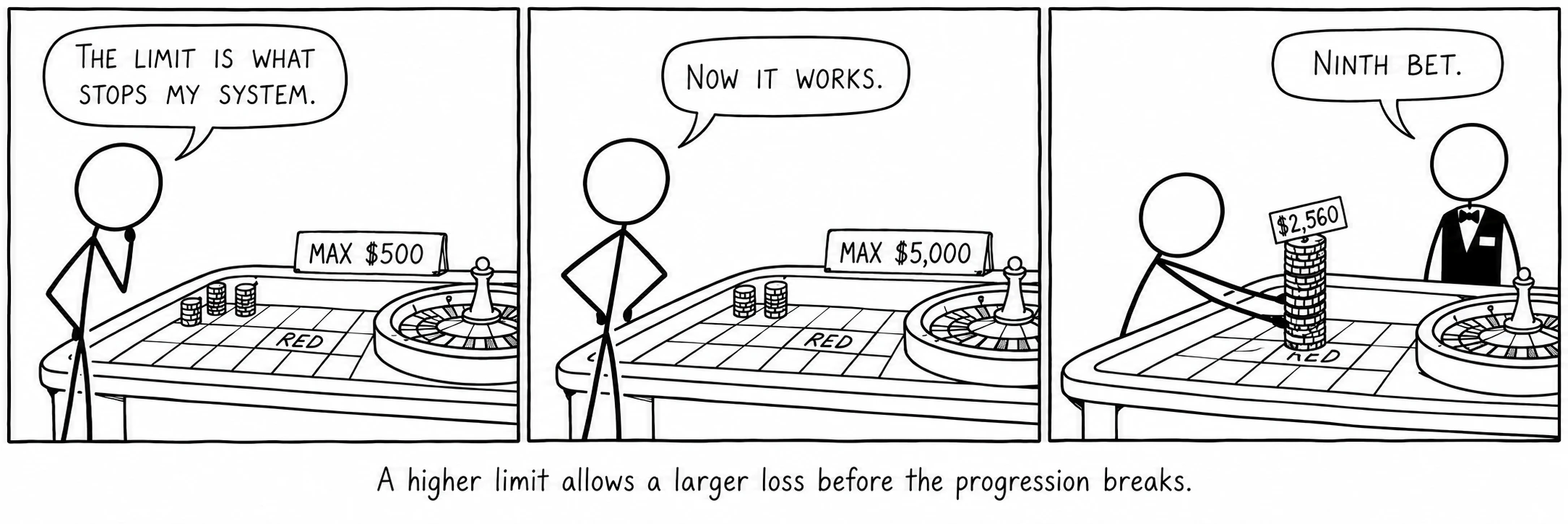
Mas talagsa ug mas dako, sa matag limitasyon. Ang produkto pirmi.
Mga Tinubdan
- Ethier, S. N. The Doctrine of Chances: Probabilistic Aspects of Gambling.
- Thorp, E. O. “Optimal gambling systems for favorable games.”
- Thorp, E. O. The Mathematics of Gambling.
- Epstein, R. A. The Theory of Gambling and Statistical Logic, 2nd ed.